
In this article 11 topics
- The first rule: responsibility follows the source of the water
- A responsibility matrix: five sources, five answers
- Before deciding who is at fault: four types of damp
- How to test without breaking anything, and what the report must include
- What to do from the moment you discover damp
- Insurance: what the standard policy actually says
- In a new building: check with the contractor first
- What is done abroad, and what can be adopted
- When there is no agreement: the Land Registration Superintendent
- Common mistakes, and why they happen
- How we do it
When damp comes from the roof or from a neighboring apartment, responsibility is determined by the source of the water, not by where the stain appears. A defect in a common roof or in common piping is the responsibility of the representative committee (the elected body that manages the common property of an Israeli condominium building) and is funded by all the apartment owners, while a defect in an apartment's private piping is the responsibility of its owner. That is why the most important step is diagnosing the source correctly, before any repair: a committee that repairs without a diagnosis sometimes pays for damage that is not its own, and a resident whose ceiling is dripping waits for months.
The first rule: responsibility follows the source of the water
Under Israel's Land Law, common property is every part of the building except the parts registered as apartments. The definition explicitly includes the roofs, the exterior walls and the water and heating installations that serve all or most of the apartments, even when they run through a particular apartment.
In practice, a main sewer line or a central water pipe running through an apartment's wall is still common property. A pipe that serves only the kitchen or the shower of one apartment belongs to that apartment, and its owner is responsible for it.
Section 58 of the law requires every apartment owner to contribute to the expenses of properly maintaining the common property, according to their share in it, unless the bylaws say otherwise. Before any decision, check the building's registered bylaws, because the standard bylaws in the schedule to the law apply only to matters the registered bylaws do not cover.
A responsibility matrix: five sources, five answers
This table is worth keeping in the building's file. It heads off the first argument, because each side can see in advance what happens once the source has been determined.
- A roof not attached to an apartment. Common property. The committee repairs it, all apartment owners pay according to their share, and the claim goes through the common property insurance, if there is one.
- A roof or roof terrace attached to an apartment (assigned to its exclusive use). Here the answer depends on the wording of the attachment, the registered bylaws and the source of the defect: the building's waterproofing layer, or flooring and systems the apartment owner installed. This is a point worth clarifying with a lawyer before deciding who pays.
- Common piping: main sewer line, central water line, gutters. Common property, even when the leaking section runs inside an apartment. The committee repairs it and funds the work from the common fund.
- Private piping in the apartment above or in an adjacent apartment. The responsibility of the owner of the apartment the water comes from. The standard bylaws allow an apartment owner to require the owner of another apartment to repair anything in that apartment whose non-repair could harm their own.
- Exterior wall, windows and the sealing around them. The exterior wall is common property. The window itself and the sealing between it and the wall are a frequent point of dispute, so it is worth the committee setting a policy in a written decision, before the first case.
The standard bylaws give every apartment owner the right to require the committee to carry out a repair in the common property when failing to do it could harm their apartment or its value. In other words, the resident on the top floor is not supposed to fund the waterproofing of the roof above them alone.
Before deciding who is at fault: four types of damp
Not every stain is a leak. The UK government's guidance for landlords distinguishes four types, and recommends an on-site inspection rather than a diagnosis from photos. It also notes that several causes can exist at the same time, and that removing mould from a wall without treating the cause will not stop it coming back.
- Condensation. Stains in cold corners, above windows and on the ceiling under an uninsulated roof, mainly in winter and unrelated to rain. It is a ventilation and insulation problem, and no neighbor is to blame for it.
- Rainwater penetration. The stain appears or spreads after rain, and dries out in summer. The source is usually the roof, a gutter, the exterior wall or the area around a window.
- Pipe leak. It does not depend on rain but on use: a shower, a washing machine or a toilet flush in the apartment above. A simple test: turn off all the taps in the suspected apartment and check whether the water meter keeps moving.
- Rising damp from the ground. On the ground floor and in the basement, a damp band at the bottom of the wall. The source is the waterproofing of the foundations and the below-ground walls.
Two questions narrow down most cases: does the stain get worse after rain, and does it get worse after water is used in a nearby apartment? It is worth recording the answers in a short log, with dates and photos, even before the professional arrives.
How to test without breaking anything, and what the report must include
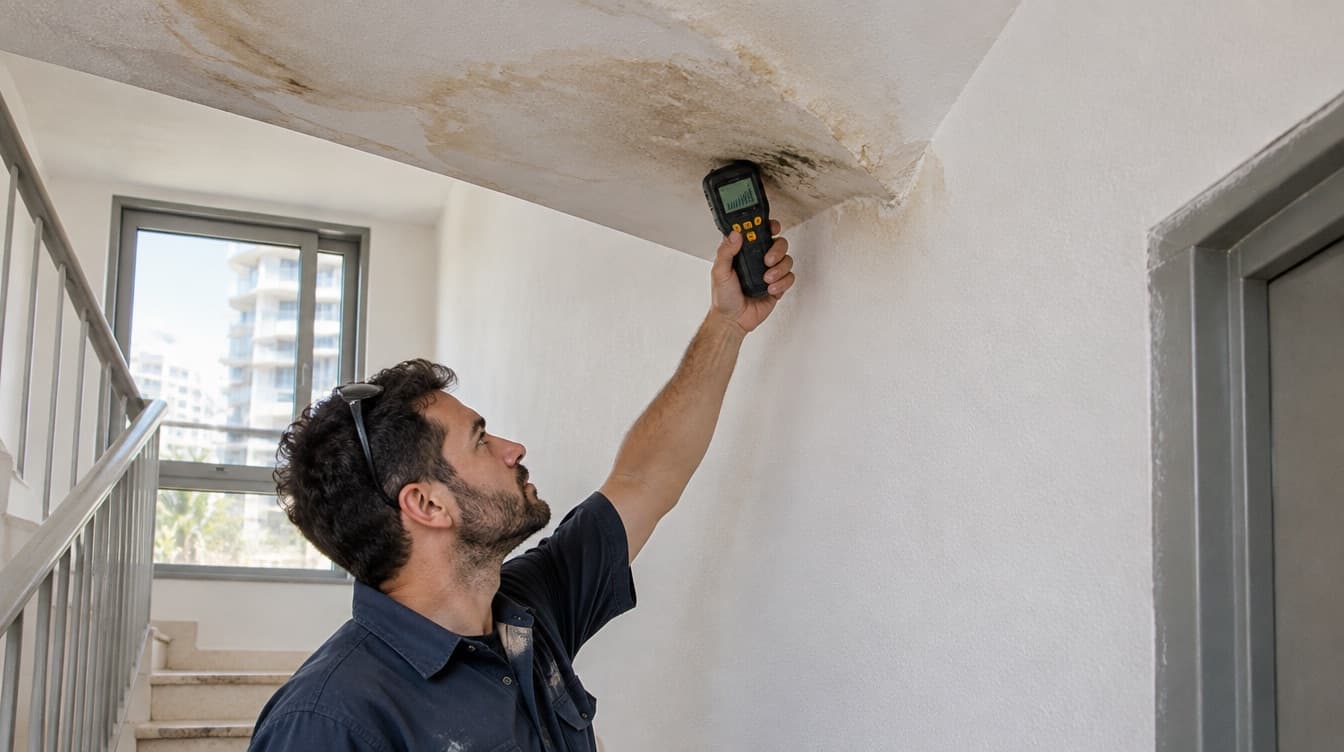
Professional leak detection combines several methods. A thermal camera shows temperature differences, not water, so its findings are verified with a moisture meter. A pressure test on the lines isolates the water piping, and tracer dye in the drains locates sewage and shower leaks.
A flood test of a roof or terrace calls for caution. The American standard ASTM D5957 for flood testing is intended for horizontal waterproofing over occupied spaces, such as terraces and car parks, and states that it is not intended for roofing systems. The depth of water adds load to the structure, so on an older roof it is better to consider electronic detection of breaches in the membrane, under ASTM D7877, where the roof build-up allows it.
What to require in writing from the leak detection company, before hiring it:
- An explicit determination of the source: roof, common line, a specific apartment's piping, condensation, or "not determined".
- Which test methods were used, and exactly where.
- A map of the moisture meter readings on a drawing, with photos.
- A repair recommendation for the source, separate from the recommendation for repairing the finishes.
- A statement that the inspector does not carry out the repair, or a disclosure if they do.
The last item matters more than it seems. Whoever both diagnoses and repairs tends to find a big problem, so separating the two protects the committee and the neighbors.
What to do from the moment you discover damp
- Stop the water if there is active dripping, and keep electricity away from the wet area.
- Document before touching anything: photos, the date of discovery, and repeat documentation a few days later to see whether the stain is spreading.
- Give written notice to the owner of the neighboring apartment or to the committee, with the photos. A phone call proves nothing later.
- Order leak detection and a report that follows the list above.
- Notify the insurer before the repair, so the loss adjuster can see the damage.
- Repair the source first, wait for it to dry, and only then repair the finishes.
- Check again after the repair, to make sure the stain does not come back before closing the case.
An apartment owner must allow necessary work in their apartment to repair the common property. If the work damaged their apartment, all the apartment owners contribute to restoring it, according to their share in the common property expenses.
Insurance: what the standard policy actually says
Under Israel's standard home insurance policy regulations, an apartment in a condominium building also includes the insured's share of the common property. However, cover for water and liquid damage is an extension purchased at the insured's request, not part of the basic cover.
- The extension covers damage first discovered during the insurance period, caused by water that escaped from piping in the apartment or in another part of the building.
- It does not cover wear, corrosion and rust of the piping itself. In other words, the damage to the ceiling is covered, but replacing the old pipe usually is not.
- It does not apply when the apartment has stood empty for more than sixty consecutive days.
- Third-party liability insurance, which is how damage one apartment caused to a neighbor is examined, is an optional section of the policy.
In a building with no common property policy, a claim for a leaking roof is split among the policies of many apartment owners, with a deductible on each. We wrote about the differences between policies in our article on building insurance. Before any claim, check the policy's actual schedule page.
In a new building: check with the contractor first
Under the schedule to Israel's Sale Law (Apartments), the inspection period (tkufat bedek, the period in which the contractor is liable for defects) for failures in piping systems, including leaks, and for failures in the building's waterproofing, including roofs and walls, is four years. It is followed by a liability period of three years, in which the buyer has to prove the defect originates in the design, the workmanship or the materials. So in a building in its first years, damp is first of all a claim against the contractor, not an expense for the common fund. On dealing with the contractor, read our article on the warranty year in a new building.
What is done abroad, and what can be adopted
In New South Wales, Australia, the law places on the owners corporation a duty to maintain and repair the common property, and allows an apartment owner to claim from it for damage caused by a breach of that duty. The government guidance there states explicitly that piping in the internal walls of an apartment is its owner's responsibility, while piping in boundary walls and under the floor, the roof and the gutters are the joint responsibility of the owners.
The idea worth adopting is actually the simple one: a written list of who is responsible for what, approved at the general meeting and distributed to residents in advance. There is no such requirement in Israel, but it prevents most arguments before they start.
When there is no agreement: the Land Registration Superintendent
A dispute between apartment owners over rights or obligations under the bylaws, or over sharing expenses, is decided by the Land Registration Superintendent (the official tribunal for condominium disputes in Israel). If the committee or the neighbor does not carry out the repair after being asked, a claim can be filed, and the Superintendent may order the repair to be carried out.
An apartment owner who carried out the repair themselves and claims reimbursement will not always receive the full cost. So it is better to make a written request first, allow reasonable time for the repair, and keep all the documentation and reports.
Common mistakes, and why they happen
- Fixing the stain and not the source. This happens because paint is cheap and quick, and the pressure from the resident is immediate. The result: the stain comes back next winter, and now it is harder to establish how long it has been there.
- Deciding who is at fault by floor. Water travels along pipes, beams and fill layers, so the stain can appear far from the source. A decision like this damages relations between neighbors, and sometimes ends with a repair in the wrong apartment.
- Diagnosing condensation as a leak. This happens when no one asks whether the stain is related to rain or to water use. Sound piping is replaced, and the mould stays.
- Repairing before notifying the insurer. The damage no longer exists when the loss adjuster arrives, and the claim is weakened.
- No written policy for windows and attached roofs. Every case is reopened, and every decision looks to the neighbors like personal favoritism.
- Not checking the roof before winter. Cleaning gutters and drains and checking the waterproofing is small work compared with repairing several apartments.
On preventing pipe leaks, see also our article on leaks and plumbing faults in the building.
How we do it
In the buildings we manage, a resident who discovers damp opens a service call in the app, with photos, and follows how it is handled. Our service center is available 24/7, so an active leak can be reported at night too. Every repair to the common property appears in the monthly expense report, line by line, which reaches the committee by the 10th of the month.
Want someone to manage the repairs and suppliers on the committee's behalf? See building committee management and building maintenance. On the division of responsibility in a condominium building in general, read our article managing condominium buildings: who is responsible for what.