
In this article 9 topics
- When do you start, and in what order?
- Pre-summer checklist
- Cooling towers and Legionella: what is mandatory and what is good practice
- Who pays for what: the central system versus the tenant's space
- After-hours air conditioning: how to charge fairly
- "I'm hot" and "I'm cold" complaints: how to handle them
- Common mistakes, and why they happen
- What to require in writing from the air conditioning contractor
- How we do it
Central air conditioning in an office building needs to be prepared for summer already in the spring. You check the chillers and pumps, clean and disinfect the cooling towers, service the air handling units and filters, and update the controls. At the same time, you need to settle in writing who pays for what: the central system, the units in the tenant's space, and air conditioning after operating hours. A building that reaches the first heat wave unprepared gets shutdowns, complaints and arguments over bills, exactly when it is hardest to get a technician.
When do you start, and in what order?
You start while it is still possible to take a chiller offline for a working day without anyone noticing. The order: the plant room, then the distribution network, and finally the terminal units and the controls. A finding that requires a part from the manufacturer takes time, and in summer the queue at suppliers is longer.
A convenient professional framework for this is the American standard ASHRAE 180 for the inspection and maintenance of HVAC systems in commercial buildings. It requires an inventory of the components that affect the building's performance, and for each component, tasks, a frequency and "signs of abnormal condition" that call for action. In Israel it is not mandatory, but it can be attached to the contract as a minimum standard.
Pre-summer checklist
Chillers and the plant room
- Annual service by a technician authorized by the manufacturer or the supplier: refrigerant pressures, leak testing, compressors and the oil system.
- Cleaning the condenser coils on an air-cooled chiller, or inspecting the condenser tubes on a water-cooled chiller.
- A thermal scan of the system's electrical panels, to find connections that are overheating.
- Chilled water pumps: strainers, seals, vibration, and a standby pump that actually kicks in.
- A trial run under load before the heat arrives.
Two numbers worth asking the technician for
Condenser and evaporator approach: this is the difference between the refrigerant's saturation temperature and the temperature of the leaving water. When it grows over time, it is an early sign of dirt or scale building up in the tubes. Ask for the value at every service, and compare it with last year.
The temperature difference between leaving and returning chilled water: a difference lower than the design value is a well-known fault in chilled water systems. It causes additional chillers to run at part load, and wastes electricity. The common causes are valves that are open too far, dirty coils or open bypasses in the network.
Air handling units
- Replacing filters, and checking that the frames are sealed and air is not bypassing them.
- Cleaning the cooling coils and drain pans, and checking that the trap drains and no standing water remains.
- Fan belts, bearings and motors.
- Fresh air dampers that open and close as commanded by the controls.
The control system
- Schedules that follow operating hours, including holidays and shortened days.
- Setpoints, and calibration of sensors that report implausible values.
- Fault alarms that reach the service center, not only a screen in the plant room.
- Keeping trend history: without data you cannot check a complaint, a bill or a chiller's performance.
Cooling towers and Legionella: what is mandatory and what is good practice
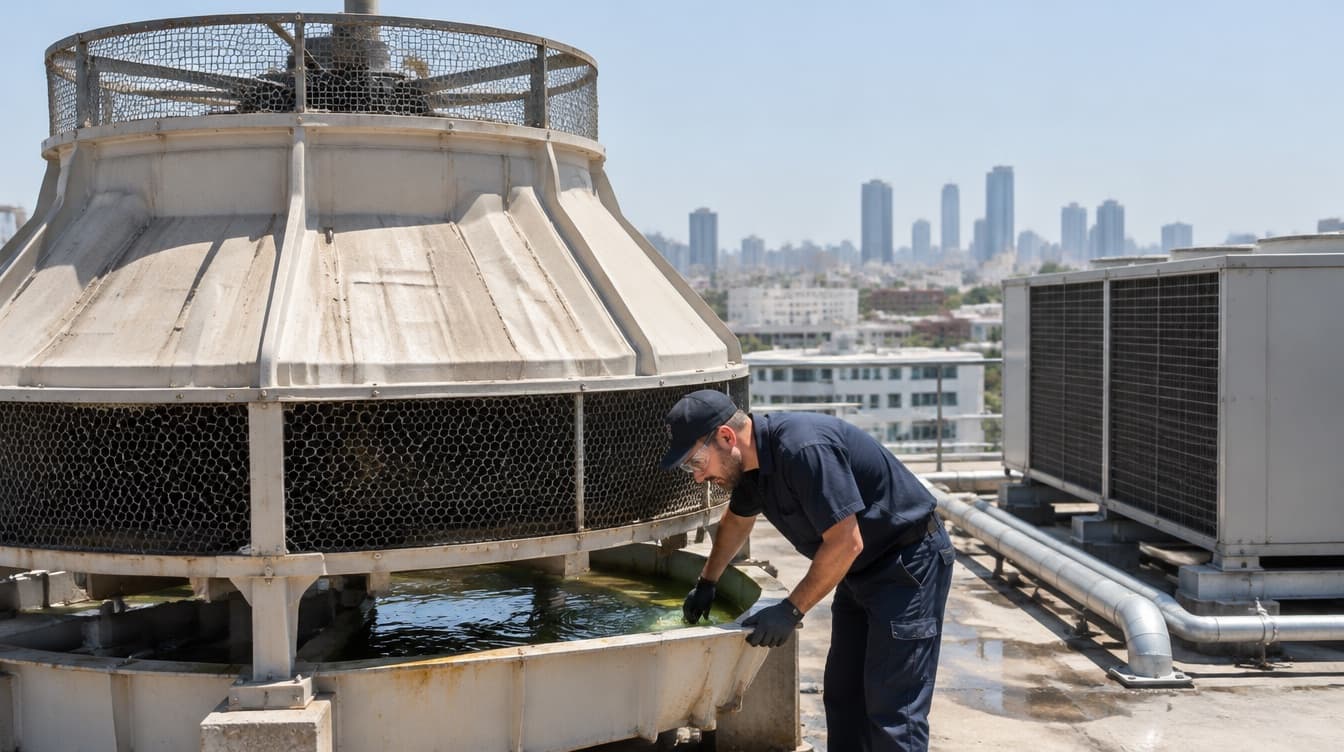
A cooling tower disperses water spray, and warm, standing water is an environment in which Legionella bacteria multiply. Israel's Ministry of Health has published guidance on preventing the growth of contaminants in aerosol-generating installations, and cooling towers are explicitly among them. These are guidelines, and they also refer to the Israeli standard SI 3666.
According to the guidelines, the site manager maps the system and assesses the risks from time to time, maintenance is based on a written plan and written procedures, and there is an appointed person with knowledge of water system maintenance. An installation that is not in use is drained or run continuously, and before it is restarted it is cleaned, disinfected and run together with the water treatment systems.
Elsewhere the structure is similar. In the UK, the Health and Safety Executive (HSE) requires, where the risk cannot be prevented, a written control scheme that defines who is responsible, and records of every action. In the United States, the Centers for Disease Control and Prevention (CDC) recommends a water management program based on the ASHRAE 188 standard. It also recommends cleaning and disinfecting before start-up after a shutdown, and keeping inspection logs and results on site.
In practical terms: a tower that stood idle all winter is exactly the case where cleaning and disinfection before start-up matter most. Ask to see the water treatment plan, the name of the responsible person and the latest sampling results before it is started up.
Who pays for what: the central system versus the tenant's space
The central system, meaning the chillers, pumps, cooling towers and controls, is part of the building systems. Its maintenance is usually funded from the service charge, according to each tenant's share. The exact rule is set in the lease, system by system, not in one general sentence.
- VRF or split units in the tenant's space: when they serve only that tenant, maintenance and electricity are usually the tenant's. An outdoor unit on the roof does not make them a building system.
- Fan coil units in the tenant's space connected to the chilled water: you need to define who replaces the filters, who handles a drain leak and who pays for repairs.
- Tenant alterations: partitions that block air outlets, or an added server room, usually require adjusting the system at the tenant's expense.
- Common areas: the lobby, corridors and toilets on each floor are air conditioned by the central system, and are included in the service charge.
One question that tends to blow up is replacing a chiller.
In the UK, the RICS professional statement on service charges in commercial property distinguishes between like-for-like replacement, replacement with an upgrade, and improvement. An upgrade can be included in the service charge when it is justified by a cost-benefit analysis. It is worth writing a similar distinction into the contract before the chiller reaches the end of its life.
After-hours air conditioning: how to charge fairly
Air conditioning operating hours are set in the building's agreed house rules or in the contract. A tenant who works in the evening or on Saturday gets air conditioning on request, and pays for what it used, according to a formula known in advance.
- One channel for requests, in advance and in writing, through the service center or the app.
- Charging by actual run time as recorded by the controls, not by estimate.
- A transparent formula presented to tenants before charging began.
- Zoning, so that a request from one floor does not run the whole building.
"I'm hot" and "I'm cold" complaints: how to handle them
A temperature complaint is one of the most common in an office building, and much of it does not stem from a fault. The ASHRAE 55 standard for thermal comfort reminds us that the sensation depends on six factors: air temperature, radiation from warm surfaces, air speed, humidity, activity level and clothing. So someone comes out, measures on the spot and checks:
- Whether the setpoint was changed, or the controls shut the zone down too early.
- Whether a partition, a cabinet or an acoustic ceiling is blocking the air outlets.
- Solar load on the facade, and an employee sitting right next to hot glass.
- More employees than the system was designed for.
A complaint that keeps coming back from the same zone gets an engineering check of the airflows, not another thermostat adjustment.
Common mistakes, and why they happen
- Starting the checks in the first heat wave. Winter is quiet, and nobody budgets for a shutdown when there are no complaints. The result: a fault at peak load, when every technician is busy.
- Replacing filters but not cleaning drain pans. The filter is visible, the pan is not. Standing water in the unit brings odors, mold and complaints about air quality.
- Control schedules not updated. Nobody is explicitly responsible for them. The building cools empty floors on a holiday, and shuts down early on an evening when a tenant is working.
- No written definition for after-hours air conditioning. The arrangement rests on custom, and then every bill becomes an argument.
- Approving a tenant alteration without an air conditioning review. The plans are checked for safety and fire, not for airflows. The problem only appears when the tenant moves in.
What to require in writing from the air conditioning contractor
- "The contractor shall maintain an inventory of all system components, with tasks and a frequency for each component, at a level no lower than ASHRAE 180."
- "At every chiller service, the refrigerant pressures and the condenser and evaporator temperature differences shall be recorded and compared with the previous service."
- "Before the seasonal start-up of a cooling tower, a cleaning and disinfection certificate and sampling results shall be delivered to the property owner."
- "Every change to setpoints and schedules in the controls shall be documented, with the name of the person who made it and the reason."
How we do it
In the buildings we manage, tenants open service calls in the app and track them, and our service center is available 24/7. Every air conditioning job appears in the monthly expense report, line by line, which reaches the property owner by the 10th of the month. In new buildings, already at the design stage, we review the system suppliers from a maintenance perspective: warranty, spare parts and local service.
For details on the service see office building management. On the line between maintaining the building and maintaining the tenant's office, read office maintenance services, and on the inspection dates for the other systems, read periodic building inspections.