
In this article 8 topics
Choosing maintainable systems for a new building means choosing by the cost over the system's whole life, not by the installation price. A system that won the tender because it was the cheapest can cost much more in electricity, spare parts, a service contract with no competition, and downtime. The decision is made once, at the design stage, and paid for every year: it goes into the management fees, and buyers and tenants ask about those before they sign.
How are bids compared internationally?
The international standard ISO 15686-5 defines life cycle cost as the cost of an asset or component over its life, while it meets its performance requirements. The standard describes how to compare alternatives over an agreed analysis period, discount future costs to present value, and check how sensitive the result is to the assumptions.
The standard distinguishes between two concepts. Life cycle cost covers construction, operation, maintenance and end of life. Whole life cost also adds income, financing and costs to users, for example a tenant whose business is shut down during a fault.
In Israel there is no obligation to carry out such an analysis. It is professional practice, and it is especially useful for a developer who holds on to the asset, or who sells units to buyers who will ask how much it will cost to own them.
A five-step method for comparing bids
- Set one scenario for all bidders. The same analysis period, operating hours, load profile and electricity price. Without this, every supplier presents the figures that suit it best.
- Request data in the same format. Consumption at part loads, a preventive maintenance plan with frequencies, a parts price list, a proposal for a service contract for the years after the warranty, and the expected service life of the main components.
- Check service life against an external source. The UK engineering body CIBSE publishes free economic life tables for building services components, in a version updated for 2026. The tables allow the value to be adjusted for installation conditions, operating hours and maintenance level.
- Discount and run a sensitivity analysis. What happens to the comparison if electricity becomes more expensive, if the service contract goes up, or if a key component has to be replaced earlier than expected?
- Add a maintainability score alongside the number. Some risks do not fit into a financial table, so they are scored separately.
A maintainability scoring matrix
Each bid gets a score on each criterion, multiplied by the weight of that criterion for the specific system:
- Competition for service: how many companies in Israel can maintain the system after the warranty?
- Openness: are the software, codes and diagnostic tools handed over to the owner? Does the building management system communicate over an open protocol such as BACnet, which is also the international standard ISO 16484-5?
- Spare parts: what is held in stock in Israel, and for how many years does the supplier commit to availability?
- Access: can components be serviced and replaced without dismantling anything or bringing in a crane?
- Uniformity: does the model match the rest of the building, or does it add yet another type that needs its own stock and know-how?
- Regulatory risk: does the component depend on a substance whose use is expected to be restricted?
The decision rule: if the gap in present value between two bids is smaller than the uncertainty range that came out of the sensitivity analysis, it is not really a gap. In that case, the maintainability score decides.
What to check in the main systems
Air conditioning and chillers
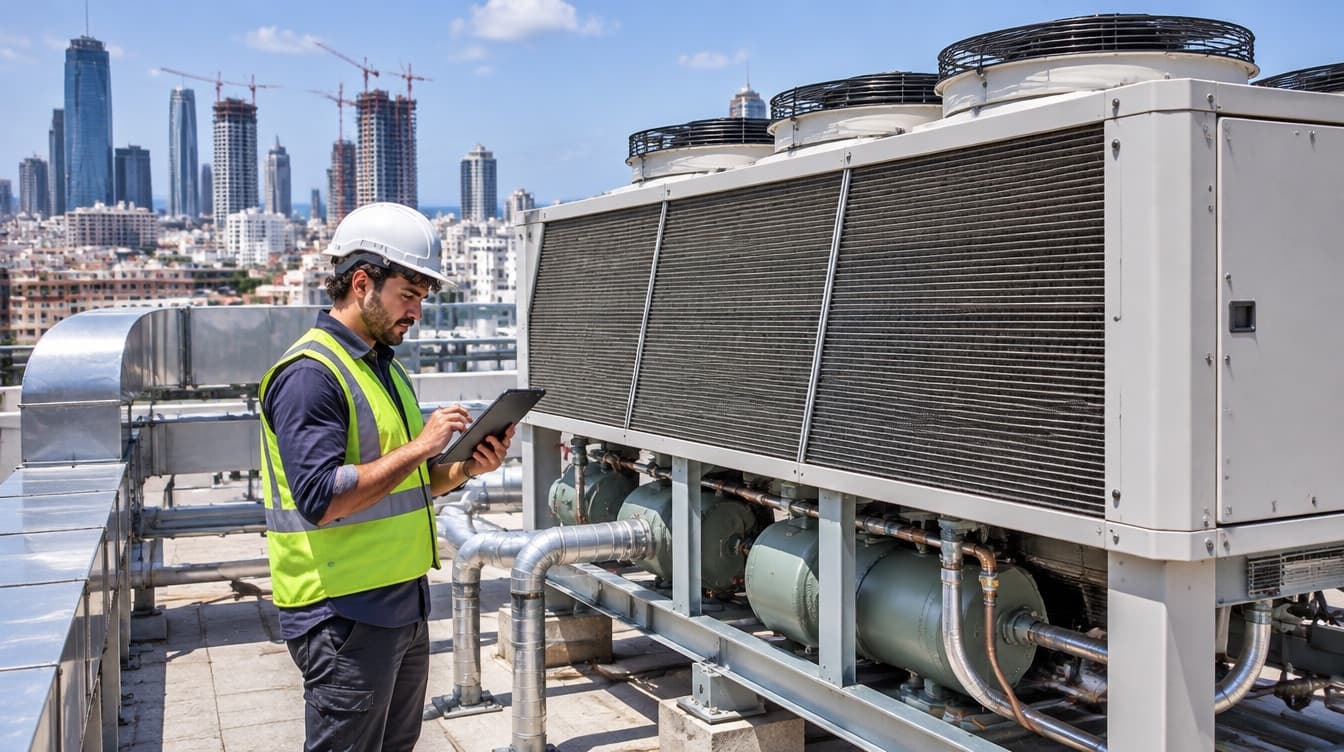
Chillers are commonly compared by IPLV, an average of efficiency at four load points, each weighted by a different share of the time, under the American standard AHRI 550/590. The calculation assumes the machine runs at full load only one percent of the time. The standard itself states that the metric is not intended to predict the energy consumption of a specific building, so it is worth requesting a calculation based on your own building's load profile.
The choice of refrigerant is a decision for decades. In the European Union, F-gas Regulation 2024/573 prohibits, from 2027, placing on the market chillers above 12 kilowatts that use a refrigerant with a global warming potential of 750 or more. Israel ratified the Kigali Amendment in 2026, and imports of HFC gases into Israel are already limited by quotas. A system chosen today on a gas that is being phased out will cost more with every refill.
Elevators
The European standard EN 13015 covers the maintenance instructions the installer must provide for new elevators. Require that the instructions, together with the diagnostic tools and codes, be handed over to the owner. A controller that only the manufacturer can open means only one possible service contract. On routine servicing, see elevator maintenance.
Fire detection, building management and pumps
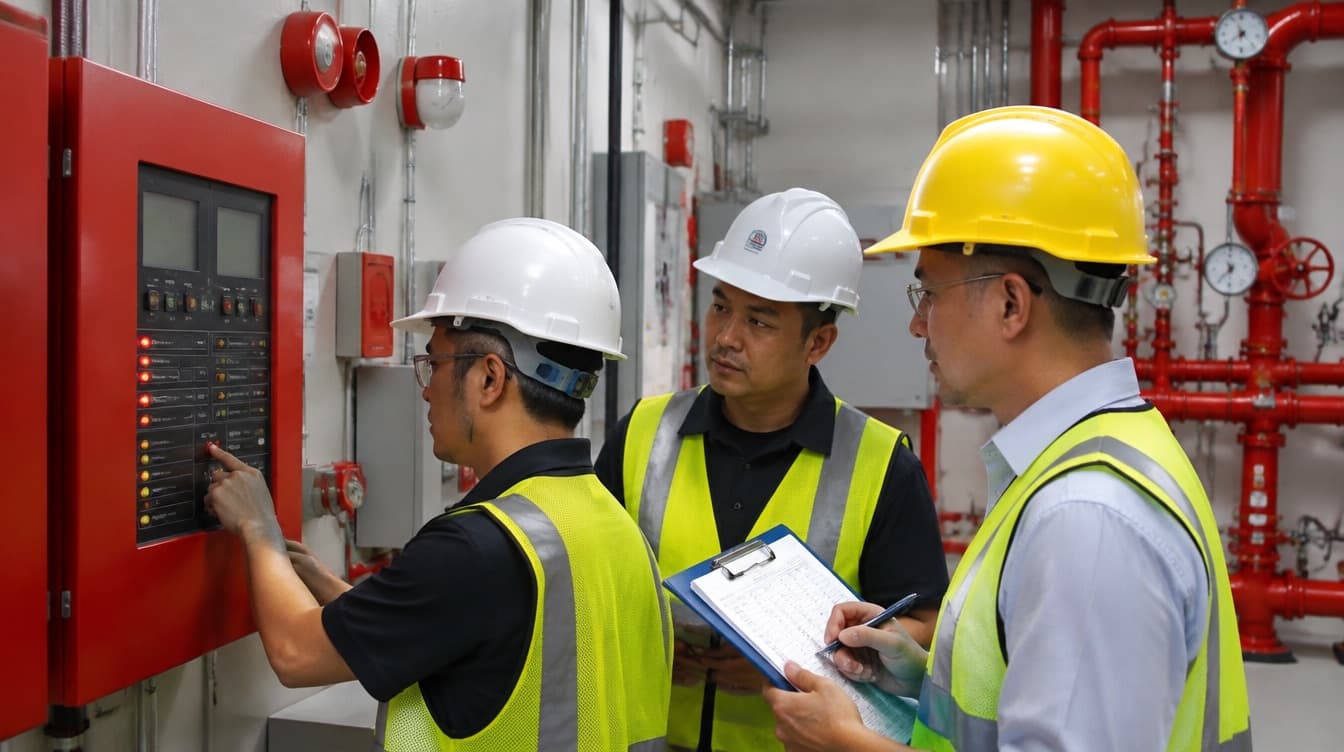
For a fire detection panel, check whether several service companies are authorized to work on it, and what its interfaces are with the elevators, ventilation and access control. For pumps, prefer a pair that alternates automatically, and one manufacturer for the whole building. For the generator, check who services that model in the area, and how a load test is carried out.
Who needs to be at the table?
The Soft Landings framework from the UK's BSRIA recommends involving whoever will operate the building from the first stage of the project, not only at handover. The 2018 edition is divided into six stages, from defining needs to extended aftercare after occupancy.
The logic is simple: whoever will get the phone call when the system gets stuck knows which questions to ask. When they are not in the room, decisions are made on the construction budget alone.
Common mistakes, and why they happen
- Comparing installation price only. This happens because the construction budget and the operating budget belong to different people. The cost: high management fees that buyers discover, and sometimes ask about as early as the sale negotiations.
- Late value engineering. Under schedule pressure, equipment is swapped after the tender without anyone checking the alternative from a maintenance perspective. The cost: equipment with no local representation, where every fault waits for a part.
- Relying on a catalog figure. Efficiency measured under test conditions is chosen because it is a single, convenient number. The cost: electricity consumption higher than forecast, every year.
- A warranty that requires the manufacturer's own service, with no price for the years after it. At tender time, no one thinks about the year the warranty ends. The cost: a service contract with no competitor.
- Handover without documentation. Documentation is pushed to the end, and the end is always rushed. The cost: a year later, no one knows what was installed or how it is set up.
What to write in the tender documents
- "The bidder will submit a life cycle cost table based on the scenario in the appendix, including energy consumption at part loads, preventive maintenance, parts and replacement of the main components."
- "The bidder will attach a binding proposal for a service contract for the years after the warranty ends, including an indexation mechanism."
- "The bidder will commit to the availability of spare parts for a defined period, even if the model is withdrawn from the market."
- "Codes, passwords, service software and diagnostic tools will be handed over to the owner, and a technician from another company will be able to work on the system without voiding the warranty."
- "The building management system will communicate over an open protocol, with a documented points list."
- "As-built drawings, operation and maintenance instructions and a parts list are a condition for accepting the system, and training for the operations team will take place before occupancy."
How we do it
At the design stage we review system suppliers from a maintenance perspective, covering warranty terms, spare parts and local service, and we build an estimate of the maintenance budget. We build the Tik Mitkan (the facility file) and the maintenance file, so the information on every system is preserved. When we also manage the building after occupancy, the knowledge gained during selection is not lost at handover.
Before closing the system tenders, read about maintenance consulting during construction. On the gap between savings in construction and the cost of operation, see the silent gap between planning and reality, and on looking after the systems after occupancy, see building systems maintenance.