
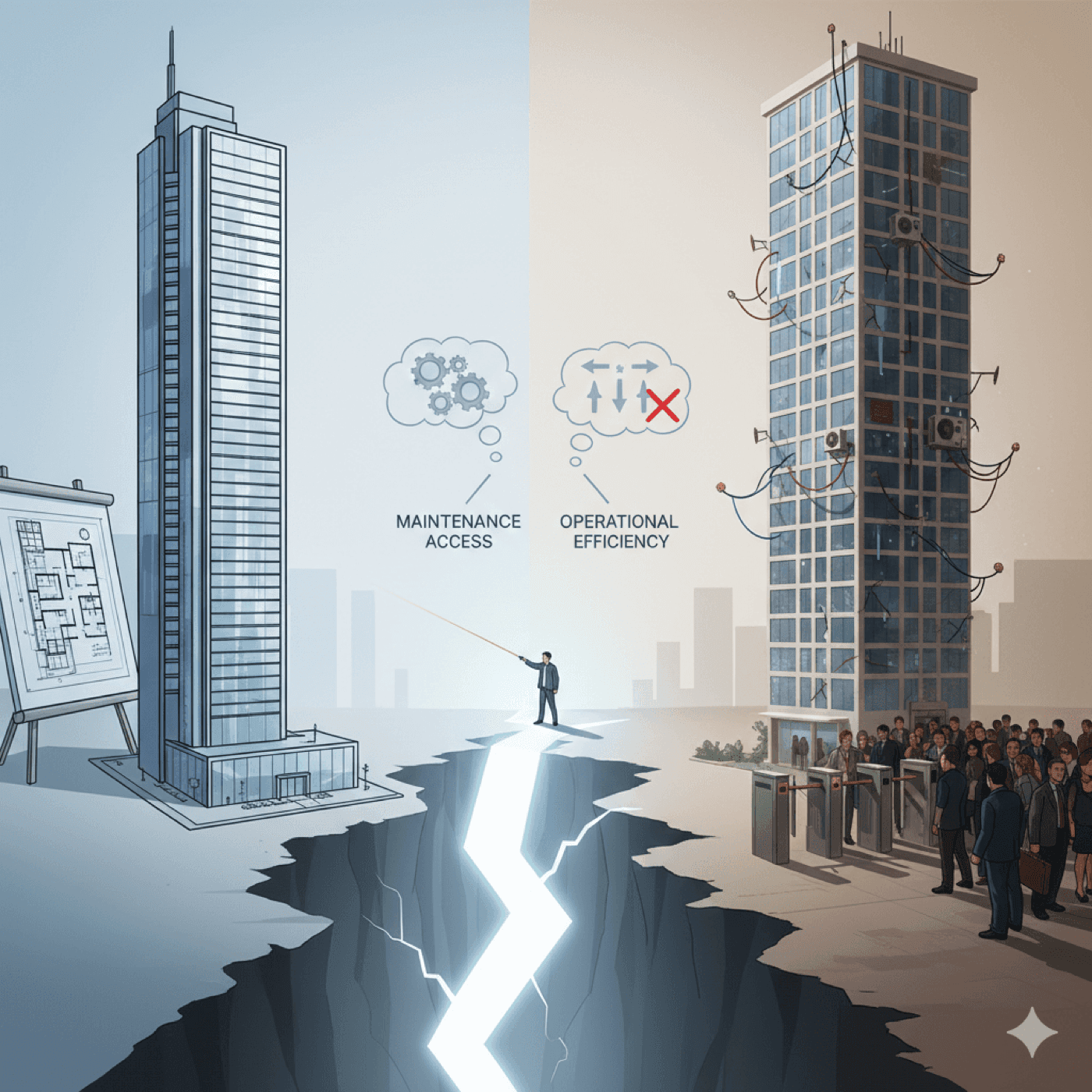
In office building management, one of the biggest and most expensive problems is the gap between the planning and construction stage and the real life of the tower on the day after handover.
Today, the target audience has to be defined at the planning stage, and the property has to be designed for it. That creates differentiation, which directly raises NOI.
On paper, everything works.
The systems are approved.
The consultants have signed off.
The contractor delivered on time.
But then the operating stage begins.
And that is where the truth comes out.
Not because the architect lacks talent.
Not because the contractor was negligent.
But because nobody asked during planning:
How will this tower function 365 days a year, for ten years?
Where does the gap actually show up?
1. Machine rooms with no real maintenance access
The drawing shows clearances.
On site, you cannot open a pump without taking apart an entire system.
Routine service turns into a project.
In office tower management, every hour of downtime costs money, a lot of it, and weakens the property's market position.
2. Access control
Poor planning of the property's entrances creates unnecessary expenses that come out of the management fees.
It can also undermine control over movement between the different uses of the building.
If this is not planned early, with the necessary preparations, it is much harder to solve at the operating stage.
Elevator management and planning also matter here, for control over how people move through the property.
3. Parking facilities and control systems without full operational control
Dividing parking spaces between the uses and grouping them so they can be controlled.
Preparing to split the parking entrances, so that regular tenants' spaces are protected from occasional visitors.
- Public areas that were not designed for daily maintenance
Beautiful but sensitive finishes.
No convenient water points for the cleaning crew.
No planned, efficient work route.
Systems installed that drive up ongoing maintenance costs.
In practice, cleaning costs rise and wear happens faster.
Why does this happen?
Because the planning stage focuses on:
- Construction costs
- Meeting standards
- Aesthetics
- Schedules
- Marketing and sales
But it hardly focuses on:
- Life cycle cost
- Maintenance access
- Day-to-day operations
- Long-term control
- A real user experience
- Creating differentiation and an advantage for the property.
This is exactly where early involvement of a maintenance consultant or an experienced management company changes the whole picture.
What does early involvement really save?
When a maintenance consultant accompanies a project from the planning stage:
Every system is reviewed through operational eyes
Equipment choices are challenged on maintenance cost, not just purchase price
Full control for the management company is ensured
A realistic maintenance budget is set before occupancy
Risky dependence on exclusive suppliers is avoided
Recurring faults in the first years are reduced
A legal framework is planned that benefits the developer and will protect the property's positioning and appearance in the future.
In office tower management, a small decision at the planning stage can affect millions of shekels over the life of the asset.
The question every developer should ask
Instead of:
"How much does it cost to build?"
Ask:
"How much will it cost to operate in the first ten years?"
A difference of a few percent in the construction budget
can be the difference between an efficient, fully occupied tower and a tower that creates constant friction with its tenants.
The real point
Office building management starts long before handover.
Early maintenance involvement is not an extra expense.
It is a mechanism that protects the value of the asset.
And it is the difference between a tower that looks good on opening day
and a tower that still performs excellently ten years later.