
In this article 10 topics
- How do you choose a method? The hierarchy for work at height
- The most important decision is made at the design stage
- How often is a tower facade cleaned?
- What do the Israeli regulations require?
- What is done elsewhere beyond this?
- What to ask the contractor for before it goes up on the roof?
- What does the property owner need to keep in working order?
- Common mistakes, and why they happen
- How do you coordinate with tenants?
- How we do it
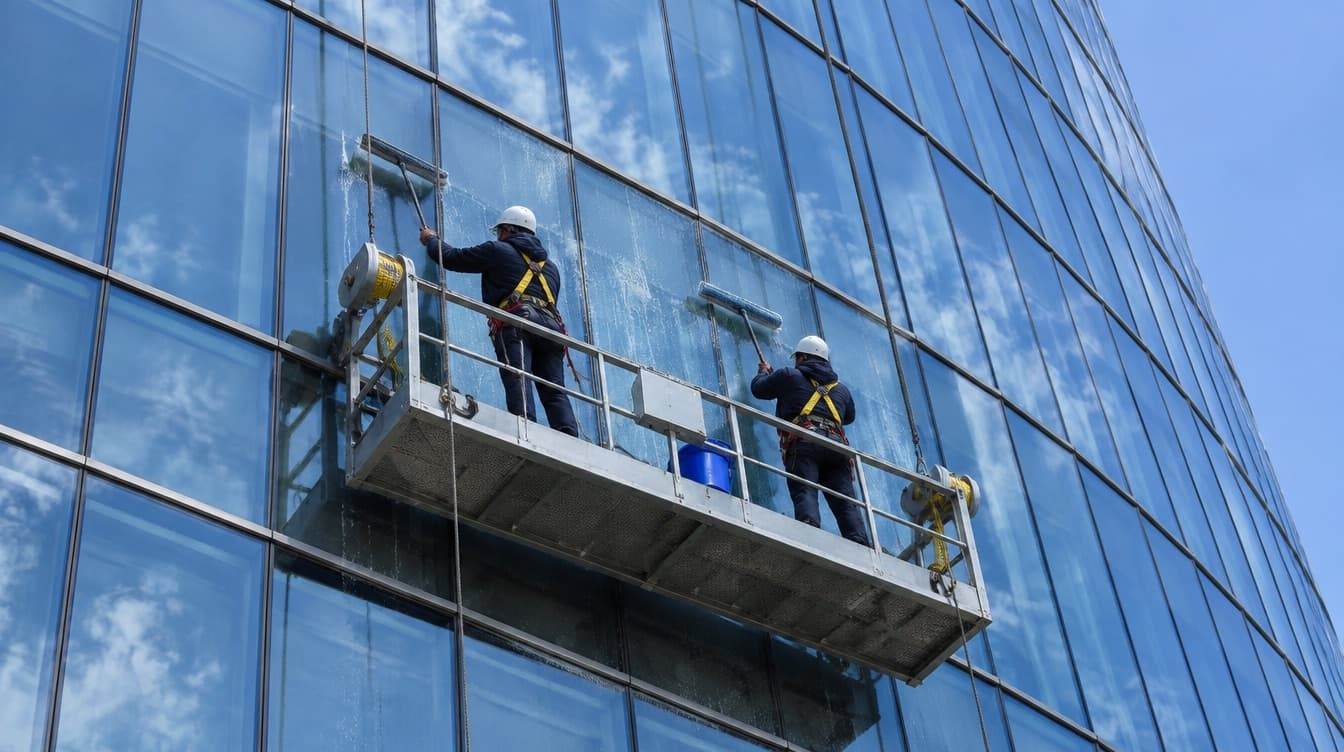
Facade and window cleaning in a tower is done with three main methods: a permanent cleaning system on the roof, rope access, or elevating work platforms for the lower floors. The frequency depends on the surroundings, the type of facade and the character of the tenants. Safety is governed by Israel's Work Safety (Work at Height) Regulations, as amended with effect from 16 October 2026. The property owner influences it more than it seems: the owner decides whether there is a working permanent system, whether the anchor points have been inspected, and which contractor goes up on the roof.
How do you choose a method? The hierarchy for work at height
At the UK's Health and Safety Executive (HSE), the guidance on window cleaning is built as a hierarchy: first, avoid working at height, for example by cleaning from inside or with water-fed poles from the ground. If that is not possible, work from an existing safe place or from access equipment with guardrails. Only as a last step do you use fall arrest equipment, which reduces the consequences of a fall but does not prevent it.
The regulations in Israel reflect similar logic for rope access work. Under regulation 32, the professional manager must make sure that rope access is the necessary, reasonable and safe method, including that there is no permanent, working system on the roof for cleaning windows and curtain walls.
What this means for the property owner: a permanent system that is out of service because of deferred maintenance does not just make cleaning more expensive. It moves the work to a method that the regulations themselves treat as a last resort.
- A permanent roof system: an arm or track with a cradle that descends along the facade. Stable and efficient for large glass facades, and it requires maintenance and inspections of its own.
- Rope access: for corners, projections and areas the permanent system cannot reach.
- Elevating platforms: for the lower floors, the retail frontage, canopies and entrances.
The most important decision is made at the design stage
How the facade will be cleaned is decided when the tower is designed, not when a contractor is hired. In the UK, BS 8213-1 deals with the design of windows for safety in use and during cleaning, and BS 6037-1 gives guidance on the design, installation, testing and maintenance of permanently installed suspended access equipment. The European standard EN 1808 sets the safety requirements for such equipment.
At the design stage, it is worth asking: does the arm reach every facade, including corners and setbacks, and are there anchor points for rope access where the system does not reach? Do the facade materials and seals withstand the cleaning method that will be chosen? Every "no" here turns into more dangerous and more expensive work at height for decades.
How often is a tower facade cleaned?
- Location: proximity to the sea, a busy road or a construction site makes the glass dirty faster.
- Facade type: glass, stone and aluminum get dirty differently and look different.
- Seasons: after winter and after dusty periods, cleaning makes a more noticeable difference.
- The tenants: premium offices and a retail frontage demand a higher standard, and sometimes there is a commitment to it in the lease.
- Floors: street-level floors get dirtier, so they are cleaned more often.
It is worth using every cleaning round as an inspection too. A crew that covers the entire facade can report cracked glass, a detached seal or loose cladding long before they become a problem. Ask for a findings report with a photo and the floor, not just "done".
What do the Israeli regulations require?
Work at height is any work, including access to the workplace, in which a worker may fall a depth of more than two meters. It also includes work from a mobile elevating work platform, a personnel basket or a powered scaffold. These are the main requirements for facade cleaning:
- A trained, certified worker: only an adult worker trained by a work-at-height instructor, with a valid training certificate for the field. The certificate is issued for two years at most. The amendment that took effect on 16 October 2026 provides that on a construction site for which notice of the start of construction work has been given, the instructor must be on behalf of a training institution, a safety officer or a registered work manager, with a transitional provision for existing instructors.
- Rope access only by a registered building rope worker, under the direct and continuous supervision of a professional manager for rope access work.
- Two separate systems: the rope worker is connected to a suspension system and to a fall arrest system, each working independently of the other.
- A logbook on site: with the rope anchoring diagram prepared by the professional manager, and a signed confirmation of the equipment check before every working day.
- Weather: rope access at night, in strong wind or in heavy rain only under explicit written safety instructions from the contractor.
- A marked danger zone, with an additional person on behalf of the contractor who keeps eye contact with the rope workers and keeps passers-by away.
- A lifting device with an inspection report: an elevating platform or a powered suspended scaffold requires a thorough examination by a certified inspector. The device is operated by a certified operator, and checked every day before use.
- Permanent anchor lines: installed with the approval of a certified inspector or an engineer, inspected at the frequency set by the manufacturer, and a copy of the inspection is shown to the contractor before work begins.
The register of rope workers, professional managers and work-at-height instructors is open to the public, and you can use it to check the people who come to the building. The requirements here were checked against the text of the regulations as published in 2007 and against the amendment that took effect on 16 October 2026. The amendment deals mainly with training workers on construction sites and with training institutions, and did not change the rules for rope access, anchor lines and lifting devices. Before work begins, it is worth going over the requirements with the safety officer.
What is done elsewhere beyond this?
- The building owner certifies the anchorages in writing. In the United States, the OSHA rule for rope descent systems requires the building owner to inform the employer in writing, before use, that each anchorage has been identified, tested and certified. The certification is renewed at least every ten years. In Israel this is not a requirement in this form, but it is exactly the document worth having ready on your side.
- A real rescue plan. The British guidance states that it is not acceptable to rely solely on the emergency services to rescue a worker stuck at height. The plan should be coordinated with the property owner, and every worker should know it before work begins.
- Coordination between client and contractor. The same guidance stresses that the building owner knows the structure better than any contractor, so the risks are assessed together and not only by whoever does the work.
What to ask the contractor for before it goes up on the roof?
- A list of workers, a valid training certificate for each one and, for each rope worker, registration as a building rope worker in the register.
- The name of the professional manager supervising the rope access, and proof of their registration.
- A valid certified inspector's report for every lifting device in use.
- A work plan: method, order of facades, anchor points and danger zones.
- A rescue plan: who performs the rescue, with what equipment, and how, without relying only on the rescue services.
- A certificate of insurance valid for the entire work period, including subcontractors.
It is worth checking the scope and wording of the insurance with the property's insurance advisor. A recurring issue is a rope access subcontractor that does not appear on the main contractor's certificate of insurance.
What does the property owner need to keep in working order?
- A maintenance contract for the permanent cleaning system, and valid inspection reports.
- Inspection records for the anchor points and lines, with a roof plan that marks every point.
- Safe access to the roof, and a procedure for who gets a key and when.
- The facade drawings and the manufacturer's instructions for the glass and seals, so that cleaning does not damage them.
Common mistakes, and why they happen
- Choosing a contractor by price per floor. The low price usually comes at the expense of planning, supervision and a rescue plan. The difference only shows on the day something goes wrong.
- Deferring maintenance of the permanent system. Tenants do not see it, so it is the first thing to be deferred. When it is out of service, the whole facade moves to rope access.
- No record of the anchor points. After a few changes of contractor, nobody knows which points were inspected and when. Every new contractor ties on to whatever looks strong to them.
- Not notifying tenants. A worker outside a meeting room without warning produces a privacy complaint, and a window opened in the middle of the work endangers the rope worker.
How do you coordinate with tenants?
- Advance notice to every floor, with dates and the side of the facade.
- A request to close windows and blinds, and to clear items from windowsills.
- Coordination at street level: entrances, cafe seating, parking and pedestrian passage.
- An update when work is postponed because of wind or rain.
How we do it
In the towers we manage, independent quality control also inspects in the field what is done on the facade. Tenants open service calls in the app and track them, so a window left dirty or a damaged seal gets handled. A 24/7 service center is available for any incident, including during the work.
Want to check the facade cleaning arrangements in your tower? Read about building cleaning and office building management. If the tower is still in design, read about pre-construction consulting.