
In this article 10 topics
- Is "preventive maintenance" one thing?
- Stage 1: an inventory of systems, and a criticality rating for each item
- Stage 2: what to do, and how often?
- Stage 3: work instructions that can be carried out and checked
- Stage 4: records that feed back into the plan
- What do you measure to know the plan is working?
- Common mistakes, and why they happen
- How do you connect the plan to the budget?
- What to require in writing from whoever maintains the property
- How we do it
A preventive maintenance plan for an income-producing property is built in four stages: an inventory of systems with a criticality rating, defined tasks and frequencies for each item, work instructions, and records that feed back into the plan. After that, you measure whether it is actually being carried out and whether it improves anything. Without such a plan, maintenance becomes a reaction to faults: equipment wears out faster, the budget is set after the fact, and tenants feel the fault before you know about it.
Is "preventive maintenance" one thing?
No. The European standard on maintenance terminology, EN 13306, distinguishes between several types, and that distinction is the basis of every good plan:
- Predetermined maintenance: work done by time or by operating hours, without first checking the condition of the equipment. For example, replacing filters at a fixed interval.
- Condition-based maintenance: you measure some indicator, such as vibration, temperature or current, and act when the value crosses a threshold set in advance.
- Corrective maintenance: repair after a fault. Sometimes this is a correct and conscious choice, for example for a simple light fixture with a replacement on the shelf.
The decision rule: life safety and legal obligations always get predetermined maintenance. Expensive equipment with measurable warning signs suits condition-based maintenance. Cheap, non-critical equipment with a readily available replacement can run to failure, provided this is a written decision and not neglect.
Stage 1: an inventory of systems, and a criticality rating for each item
You cannot maintain what you do not know exists. Each item gets a record card: name, location, manufacturer, model, serial number, year of installation, who maintains it, and any warranty or contract in force. The sources are the Tik Mitkan (the facility file), the as-built drawings and the manufacturer's instructions, and where they are missing, an orderly walk through the plant rooms and the roof.
The step most plans skip is the rating. A simple matrix of three axes, each scored from 1 to 3, is enough to set priorities:
- Safety and law: does a failure endanger people, or is the item subject to a legal inspection requirement?
- Impact on tenants and income: does a failure stop operations, or close a floor or the parking garage?
- Recoverability: is there a standby unit, and how long does it take to get a spare part?
An item that scores high on the first axis goes into the group of mandatory tasks, regardless of the other axes. The rest are ordered by their total score, which makes it clear what is not given up when the budget is tight.
In the UK, a maintenance specification called SFG20 is widely used: a library of task specifications in which every task is color-coded by criticality. Red marks a task arising from a legal obligation, amber a task critical to operation, pink a task the organization itself has made mandatory, and green a discretionary task. It has no binding status in Israel, but its logic fits almost any income-producing property.
Stage 2: what to do, and how often?
Frequency has four sources: the manufacturer's instructions, the law, professional standards, and the experience of the property itself, such as proximity to the sea, dust and operating hours. When the sources conflict, choose the stricter one, and record why.
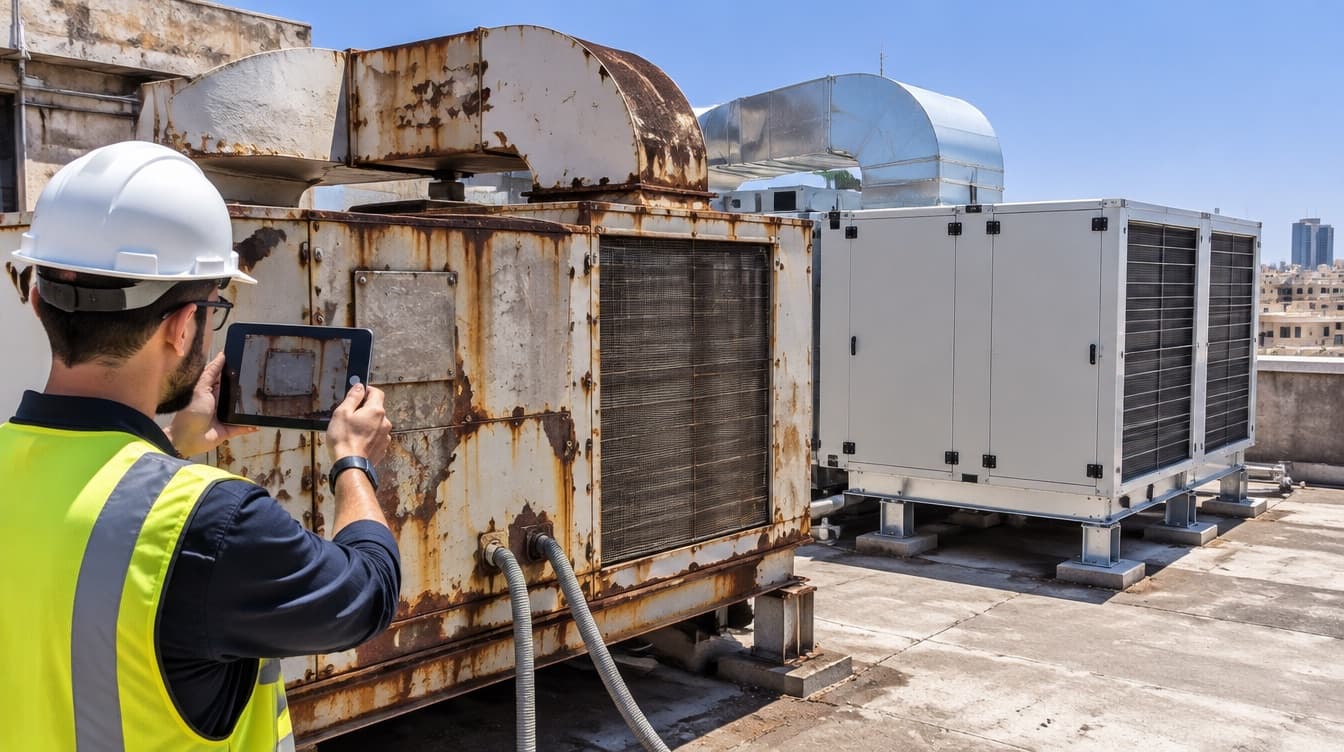
For air conditioning and ventilation systems, the American standard ASHRAE 180 gives a good structure. It requires an inventory of the components that affect the building's performance, and for each component defines tasks, frequency and "condition indicators" that require action. The question it forces you to ask is not only "when do we service it", but "what does a component that is not working properly look like".
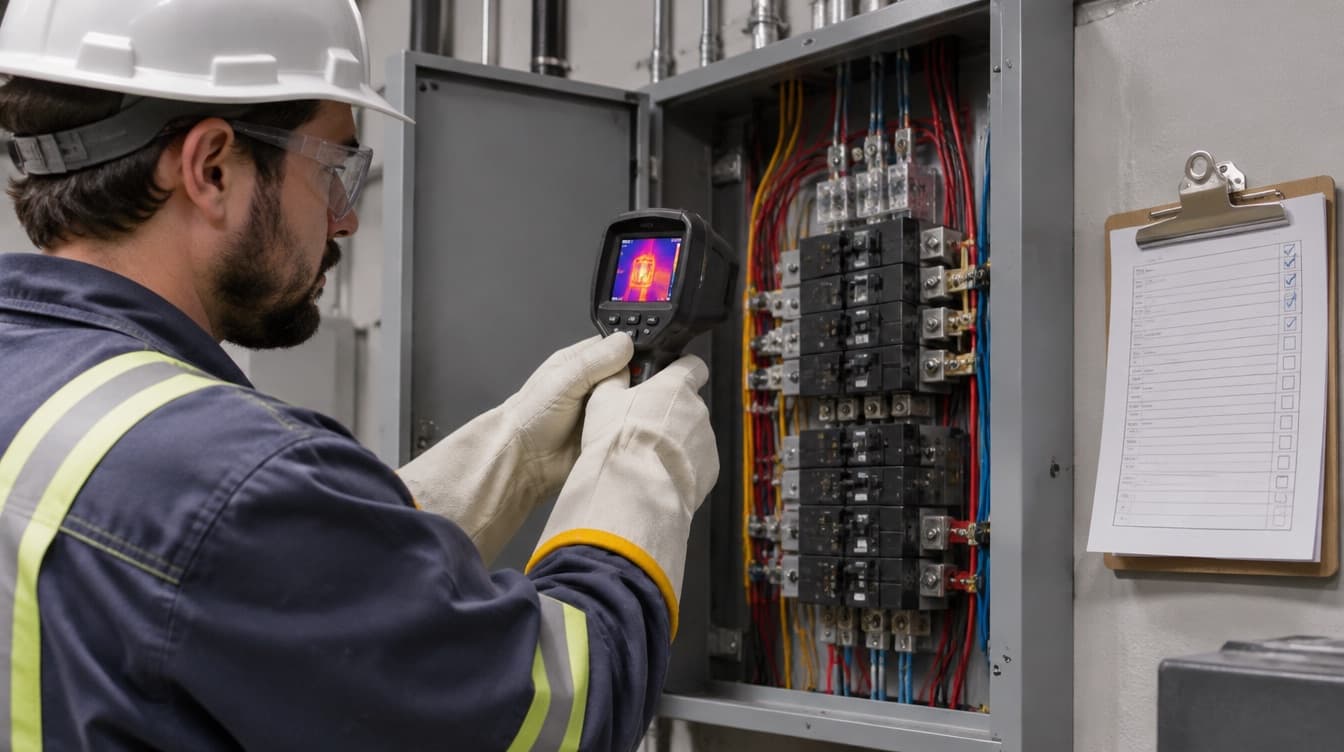
Condition-based inspections have an important rule from reliability-centered maintenance: the interval between inspections must be shorter than the time from the moment a problem becomes detectable to failure. A thermal scan of an electrical panel once every few years will not catch a connection that heats up and burns out within months. The reverse is also true: inspecting a stable component too often is a waste of hours.
We have gathered the inspections the law requires in a building in the article on periodic building inspections. In Israel there is no general law requiring a preventive maintenance plan. The law requires certain inspections, and everything else is professional practice that is worth anchoring in the contract.
Stage 3: work instructions that can be carried out and checked
A plan that sits in a spreadsheet does not get carried out. It has to become work instructions issued on schedule, to the right person. A good instruction includes:
- A closed list of actions, not free text.
- The values to record, with a normal range: pressures, temperatures, currents.
- Who performs it, the in-house team or a supplier, and under which contract.
- Permits before the work, such as work at height or disabling fire detection.
- Records on completion: a photo, findings, parts replaced, and what remains open.
Stage 4: records that feed back into the plan
Every system should have one history: when it was serviced, what was found, what was replaced and what was measured. It is needed with a manufacturer in a warranty claim, with an insurer after damage, and with a buyer in due diligence.
But its real value is in correcting the plan. If a service is repeated again and again without finding anything, its interval can be extended. If faults appear between services, the frequency is too low or the task is wrong.
What do you measure to know the plan is working?
Maintenance has a European standard for performance indicators, EN 15341, but definitions in the market vary from one body to another. So what matters is to define each indicator in writing, and to measure it every month in the same way:
- Plan compliance: the share of planned tasks carried out within a defined time window. A task performed very late does not count.
- Planned work versus breakdown work: preferably by labor hours and not by number of work orders, because one large repair is worth dozens of small inspections.
- Inspection yield: how many preventive services found a defect that required repair. Very few suggests excessive frequency, very many suggests low frequency.
- Repeat faults: the same fault in the same system, a sign that the symptom is being treated.
- Availability of critical systems: how long an elevator, a chiller or a pump was out of service.
- Backlog in work weeks: the amount of pending work divided by the available workforce. A growing figure indicates a shortage of people or budget.
- Tenant calls by system: the indicator closest to their experience.
Avoid the "accepted" targets that circulate online. Many of them have no research source that can be traced. Compare the property with itself, month against month and year against year.
Common mistakes, and why they happen
- Copying the manufacturer's instructions as they are. It is easy and protective in terms of warranty, but the manufacturer does not know the property. The result is excessive servicing of some systems and too little of others.
- Measuring only plan compliance. When it is the only indicator, tasks get closed in the system without being carried out. Only on-site sampling by someone who did not do the work exposes this.
- Not updating the inventory. A new system installed in a tenant's space does not enter the plan, and nobody services it until the first fault.
- Service contracts that do not match the plan. A contract with one visit a year does not cover a system that needs seasonal servicing. The difference arrives as an extra work order.
- Findings stay with the technician. A defect that was recorded and not escalated is worth nothing. You need a written rule on when a finding goes up to the owner.
How do you connect the plan to the budget?
Every task has a cost: labor hours, parts or payment to a supplier. The total of the tasks for the year is the preventive maintenance line, grounded and not estimated by rule of thumb.
Findings from the services feed the replacement plan for the coming years. A system whose faults are coming closer together, or whose measurements are deteriorating, is signaling that it is nearing the end of its life.
What to require in writing from whoever maintains the property
- "The supplier shall provide a full inventory of the systems with a criticality rating, and update it with every installation, replacement or removal."
- "For each task, the source of the frequency shall be stated: manufacturer, law, standard or experience, and any change in frequency shall be approved in writing."
- "The monthly report shall include the indicators defined in the schedule, using the same calculation method throughout the term of the contract."
- "A finding that affects safety, a legal obligation or a tenant shall be passed to the owner in writing, with a recommendation and a person responsible."
- "The entire history of the systems is the property of the owner and shall be handed over in an open format at the end of the engagement."
Questions for the meeting: what was postponed in the last quarter and why? Which systems do you think are near the end of their life, and based on which measurements? Which task did you space out or add this year, and following what?
How we do it
For every property we build a facility file and a maintenance file. In projects we accompany from design and manage after occupancy, knowledge is not lost at handover. Independent quality control checks on site that the plan is being carried out, and faults that still happen reach our 24/7 service center.
Want to build or review a maintenance plan for your property? Read about building maintenance, and if the property is still in design, about consulting at the construction stage. For the systems themselves, read the article on building systems maintenance.