
In this article 11 topics
- What is mandatory in Israel, and what is common practice elsewhere?
- Step 1: Which components go into the plan?
- Step 2: How long will a component really last?
- Step 3: A condition survey on a uniform scale
- Step 4: How do you decide what comes first?
- Step 5: Why is ten years not enough?
- How to fund it: a replacement fund, a reserve fund or as needed?
- What can be passed on to tenants?
- Common mistakes, and why they happen
- What should the owner receive in writing?
- How we do it
A replacement budget for an income-producing property is a capital plan for at least ten years. It sets out which components will reach the end of their economic life, roughly when, at what priority, and how the replacement will be funded. It is separate from the operating budget, and rests on a component register, a condition survey and the maintenance history. Without such a plan, a chiller, an elevator or the roof waterproofing reaches the end of its road by surprise: the replacement is done under pressure, tenants suffer from the downtime, and a single year absorbs the whole expense.
What is mandatory in Israel, and what is common practice elsewhere?
In Israel there is no general legal requirement to build a replacement plan for an income-producing property. What governs is the leases: what the owner must maintain, and what it may charge tenants through the service charge. So this is the owner's business decision, not a regulatory requirement.
Elsewhere it is already mandatory, and that is where the methods come from. In New South Wales (NSW), Australia, almost every strata building needs a ten-year capital works plan, reviewed at least once every five years, and the government recommends reviewing it every year. In California, owners' associations are in most cases required to carry out a visual inspection of the major components at least once every three years, and an annual review of the plan.
In the United States, CAI (Community Associations Institute), the organization of owners' associations, has published standards for reserve studies that require a projection of at least thirty years. In the UK, the RICS professional standard for service charges in commercial property sets out how such funds are held and what may be passed on to tenants. Together, these four sources build a method that works well for an Israeli owner too.
Step 1: Which components go into the plan?
The common mistake is to include everything, or only what someone happens to remember. The CAI standards have a simple three-condition test, and a component enters the plan only if it meets all three:
- The owner is responsible for it. In an income-producing property this is set in the leases. A system the tenant installed in its own space, and is responsible for, does not go in.
- The need and the timing can reasonably be anticipated. The cause does not have to be physical wear. Technological obsolescence, high energy consumption or the end of manufacturer support also count.
- The cost is material. That is, higher than the operating budget can absorb in a normal year, and it can be estimated with reasonable confidence.
Whatever fails the test stays in the operating budget, or goes into a general contingency reserve. That keeps the plan focused and credible.
Step 2: How long will a component really last?
Service life tables are only a starting point. The tables of CIBSE, the UK's Chartered Institution of Building Services Engineers, give a reference service life for each type of system. The new edition includes a tool that adjusts the value by nine factors, among them the external and internal environment, the maintenance level and the operating hours.
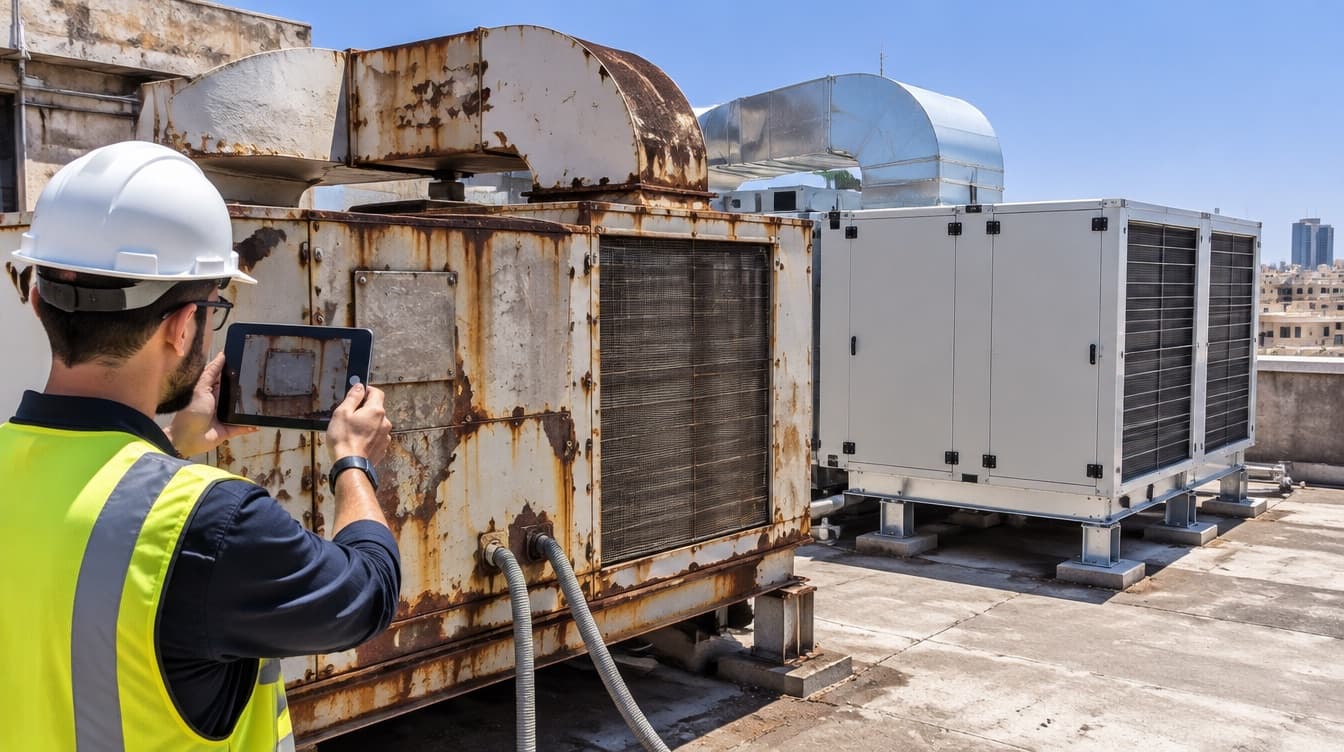
This is the same logic as the "factor method" in the ISO 15686 series of standards. You start from a reference service life, and correct it by seven factors: component quality, design level, workmanship level, indoor environment, outdoor environment, conditions of use and maintenance level. A rooftop air conditioning unit facing the sea, in an office building that operates until late, will score low on at least two of them.
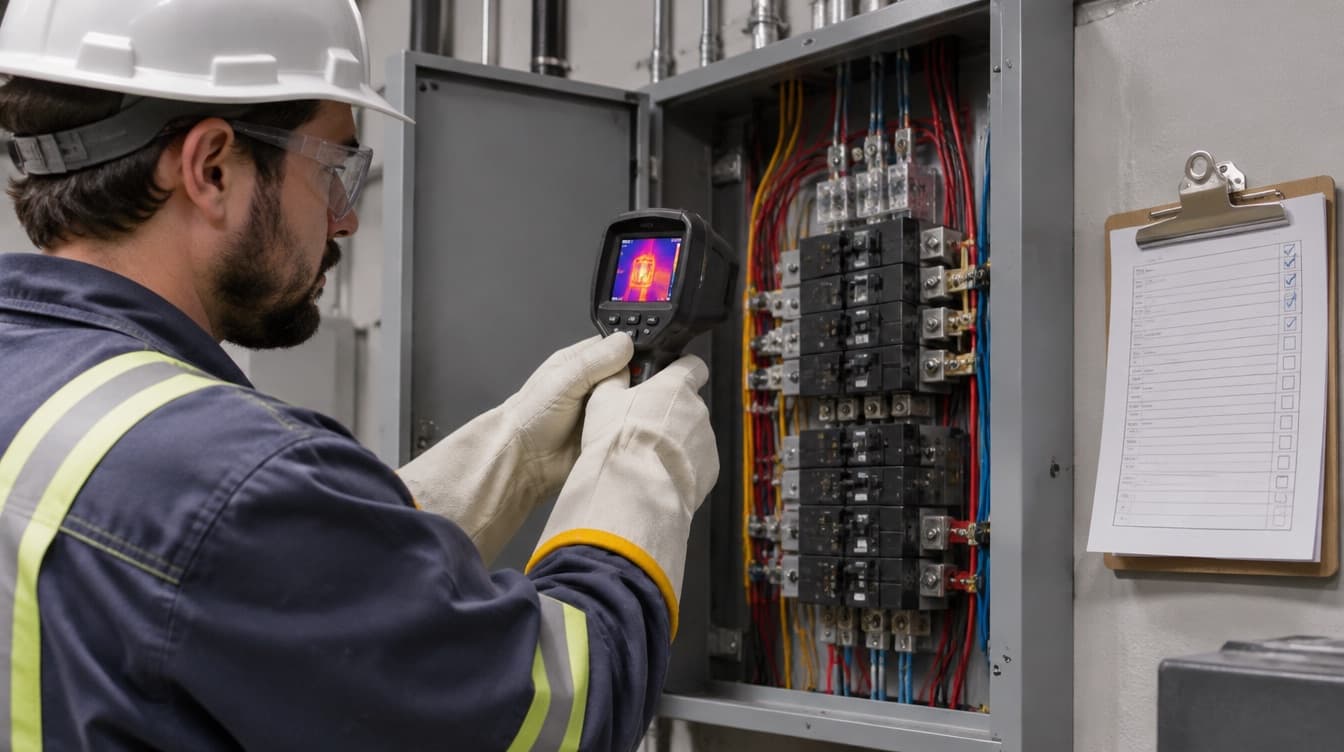
Actual maintenance changes the picture. According to CAI, a lack of preventive maintenance should shorten the estimate of remaining life. And according to RICS, a component reaches the end of its economic life when it is cheaper to replace it than to maintain it, and that is determined by an experienced engineer's inspection and the fault records, not by age alone.
Step 3: A condition survey on a uniform scale
A condition survey written in free prose is hard to compare from year to year. The Netherlands developed the NEN 2767 standard, and a European specification, CEN/TS 17385, was derived from it. They rate condition on a six-grade scale, and weigh each defect by its severity, intensity and extent.
You do not need to adopt the standard in full to benefit from the idea. It is enough for each component to receive:
- A condition grade on a fixed scale, with a written definition for each grade.
- An estimate of remaining life, and what it is based on: inspection, measurement or fault history.
- Support status: whether the manufacturer still supplies spare parts and service.
- A recommendation: keep maintaining, refurbish or replace, and when to check again.
A uniform scale lets you see the rate of deterioration. A component that dropped two grades in two years moves up the queue, even if its age looks reasonable.
Step 4: How do you decide what comes first?
A simple method that works: give each component two scores, from 1 to 3. The first is the likelihood of failure in the coming years, based on condition and history. The second is the severity of the consequence, based on the impact on safety, on tenants and on income. The product of the two sets the order.
After the calculation, check four considerations that move the queue:
- Safety and regulation come before everything, even with a low score.
- Spare parts availability. When the manufacturer announces the end of support, the time left is shorter than it looks.
- Bundling works. If a crane is brought to the roof for a chiller, that is the time to deal with the waterproofing too.
- Lease events. Renovating a floor or a common area is easier when a floor becomes vacant than when it is occupied.
Step 5: Why is ten years not enough?
A plan of exactly ten years hides what arrives in year eleven. An elevator or chiller expected to be replaced shortly after the horizon does not appear in the table, and therefore not in the contributions either. The result is a wall of expenditure that appears suddenly.
So it is worth keeping a detailed ten-year table, alongside a longer view of the major components only. That is why CAI requires a thirty-year projection.
How to fund it: a replacement fund, a reserve fund or as needed?
RICS distinguishes between two types of fund. A replacement fund accumulates over a component's life, for example for replacing elevators or air conditioning systems. A reserve fund is short-term, for a recurring expense such as external painting, so that the service charge does not jump from year to year.
To know whether the fund is healthy, use a CAI measure called percent funded. For each component, calculate the balance that should have accumulated by today: the current replacement cost, multiplied by its age, divided by its useful life. The total for all components is compared with the actual balance, which shows how much of the wear that has already happened is covered by money.
You also set a funding goal. CAI describes three: not dropping below zero, staying above a set threshold, or reaching full funding. A goal of "not dropping below zero" exposes the property to the risk that the money will not be there when a component fails earlier than expected.
More details in CAI's explanation of its reserve study standards.
What can be passed on to tenants?
In Israel the answer is in the leases, so check them before building the funding model. The RICS principles help draft new leases fairly:
- The original cost of installing systems belongs to the owner, and is not charged through the service charge.
- Replacing a component that is no longer worth repairing can be charged, provided the lease allows it.
- An upgrade beyond normal replacement is charged only when there is a cost-benefit analysis over the term of the lease.
- The owner contributes to the fund for vacant space too, as if it were the tenant.
- Fund money is held in a separate account, and interest is credited to the fund.
RICS also points to a fairness problem: a tenant who signs a short lease near the end of a system's life should not fund the entire replacement alone. A fund built up over the years solves this.
Common mistakes, and why they happen
- A plan built once and forgotten. It is built ahead of an acquisition or a financing, and afterward nobody is responsible for updating it. After a few years it no longer reflects the property.
- Planning by age alone. It is easy, because the age is known. But you replace a well-maintained system too early, and are late with one that wears quickly.
- Repeatedly deferring the same replacement to improve a particular year's results. In the end the system sets the date itself, with a breakdown and at emergency prices.
- Replacing a component without checking the whole system. A new pump on worn piping does not solve the problem, and sometimes makes it worse.
- Forgetting the control systems and software. They become obsolete faster than the equipment they run, and they are often what brings it to a halt.
What should the owner receive in writing?
- "A register of components that passed the three-condition test, with a condition grade on a fixed scale for each component."
- "For each component: the reference service life, the factors applied to it, and the basis for the estimate of remaining life."
- "A detailed ten-year table, and a longer view of the major components."
- "A projection of contributions and balances, the percent funded and a declared funding goal."
- "An annual update of the plan together with the budget, and a field survey at least once every few years."
How we do it
In the properties we manage, a detailed expense report arrives every month by the 10th, line by line, and independent quality control checks the work in the field. In projects we accompany from the planning stage, we build the Tik Mitkan (the facility file) and the maintenance file, and review system suppliers from a maintenance angle. When we also manage the property after occupancy, the knowledge about every system stays with the property.
Want to build a replacement budget for your property? Read about building maintenance, and if the property is still under construction, about pre-construction consulting. On the link between maintenance and property value, read increasing property value through management.