

In this article 12 topics
- What can be shared, and what should not be included at all?
- Splitting by area: what is the denominator, and how is it measured?
- Splitting by consumption: when does it really work?
- Cost pools: how do you split a complex with several types of tenants?
- Weighted area: why a unit ten times larger does not pay ten times more
- Anchor tenants and vacant space: who pays for the gap?
- Which service charge model did you choose, and what does it require?
- The apportionment matrix: the tool that prevents most disputes
- Advance payments and annual reconciliation: what are the deadlines?
- What to write in the lease?
- Common mistakes, and why they happen
- How we do it
In large properties, expenses are split between tenants in layers. What serves everyone is divided by area, what serves only some of the tenants goes into a separate pool, and what can be measured is billed by consumption.
A fair split matches who benefits from a service with who pays for it, in a calculation every tenant can check. A key that was not well defined in the lease creates cross-subsidies, disputes at the annual reconciliation, and expenses the owner cannot recover.
What can be shared, and what should not be included at all?
Before choosing a key, define the basket. It usually covers cleaning and security, maintenance of shared systems, electricity and water in the common areas, central air conditioning, insurance and management. A service provided to a specific tenant is billed directly to that tenant and is not shared.
In the UK, the RICS professional standard on service charges in commercial property also lists what is excluded. It is a useful list for an Israeli lease too:
- Construction costs of the building and its systems, including office equipment for the property management.
- Upgrades beyond ordinary maintenance, unless tenants were shown an analysis of alternatives and of cost versus benefit over the lease term.
- Costs that serve the owner's investment: asset management, rent collection, marketing vacant space, and matters between the owner and a specific tenant.
- The share of vacant space and of the owner's own use.
- Costs caused by negligence of the owner or the manager.
Splitting by area: what is the denominator, and how is it measured?
Splitting by area is simple, predictable and easy to explain. It suits what everyone benefits from in a similar way: the building envelope, insurance, general security and safety systems.
Two questions decide whether it is fair. The first is the denominator: RICS defines the tenant's share as the ratio between its area and the total lettable area of the property, not the area actually let. That way the share of vacant space stays with the owner and is not passed on to existing tenants.
The second question is the measurement method. In the United States, offices are measured under the BOMA standard, whose current version is BOMA 2024. It distinguishes between usable area and rentable area, which includes a proportional share of the common areas, known in Israel as the "load factor" (ha'amasa).
In Israel the method is set in the lease, so what matters is that all units in the same pool are measured the same way, and that tenants know how they were measured.
Splitting by consumption: when does it really work?
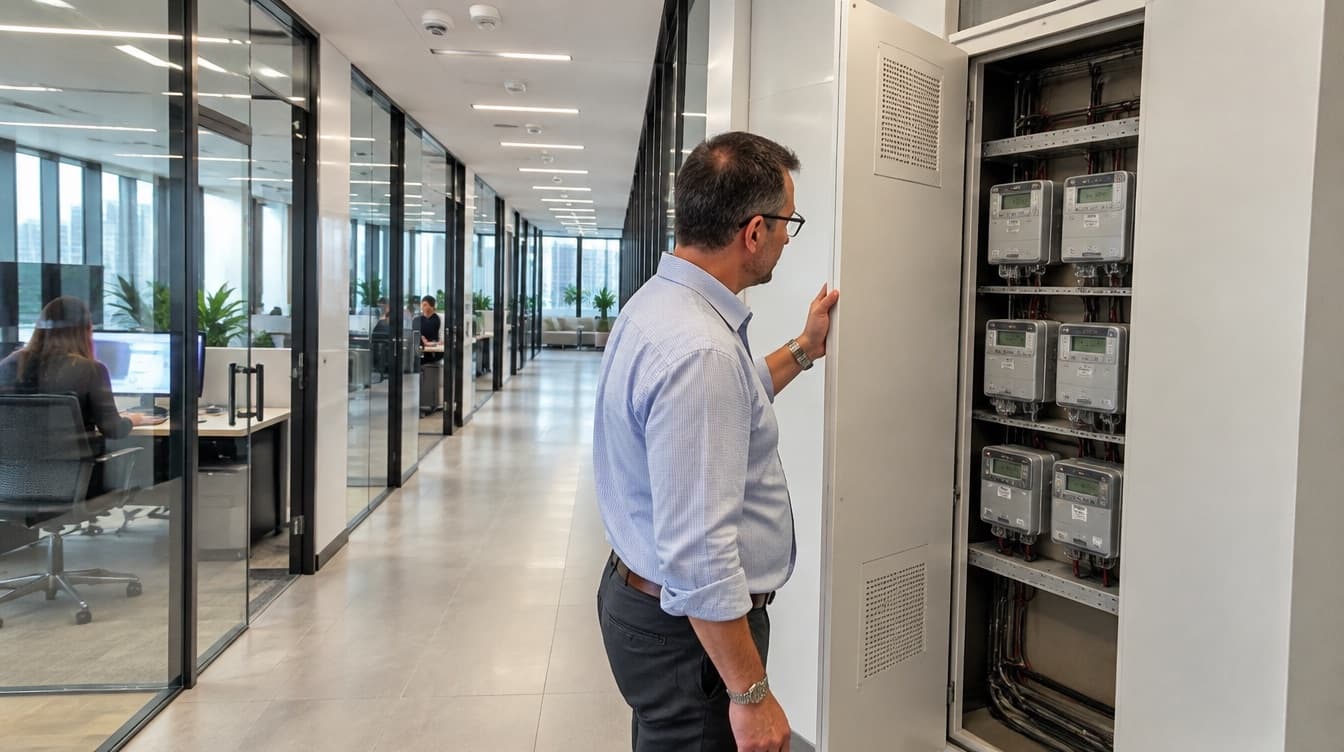
Electricity and water per unit, cooling energy from central air conditioning, and air conditioning hours beyond operating hours. RICS sees separate metering, or full sub-metering of utilities, as an essential condition for a split that reflects actual use.
But a meter is only half the solution. The bill should state the unit price and the manager's handling fee, if any, and be backed by the original invoice from the electricity or water supplier. A meter that is not read regularly, or whose calibration nobody is responsible for, turns from an allocation key into a source of disputes.
Cost pools: how do you split a complex with several types of tenants?
The British standard calls these "schedules": expenses are divided into pools by availability of the service, benefit and use, and each pool is split only among those who benefit from it. The result is that one tenant pays different percentages in different pools, and that is as it should be.
- A general pool for all tenants: envelope, insurance, safety systems, management.
- A retail pool: cleaning and security of the pedestrian mall, public restrooms, marketing the complex.
- An office pool: the office lobby, the office elevators, reception.
- A food pool: grease separators, organic waste removal, cleaning of shared kitchen hoods.
- A parking pool: by parking spaces, not by unit area.
Weighted area: why a unit ten times larger does not pay ten times more
In UK shopping centers, a weighted area method is common. The area is divided into bands, and each additional band counts at a lower percentage. The logic is that the cost of serving a very large unit does not grow in direct proportion to its area.
In an example given in the RICS standard, a unit ten times larger pays roughly six and a half times more. The standard stresses that there is no single weighting formula, and that it has to fit the size of the units, the layout and the use of the complex.
Two important limits: a reasonable and fair weighting formula is not considered a concession to the large tenant. And the weighting formula must not be changed to reduce the share the owner bears because of vacant space.
Anchor tenants and vacant space: who pays for the gap?
An anchor tenant usually gets its concession in the rent, and there the owner absorbs the gap. In the service charge, all tenants pay the same price per square meter, because the service everyone receives is the same. If the owner still chooses to give an anchor tenant a cap on the service charge, a fixed amount or an exclusion from certain pools, that is a legitimate business decision, but the gap does not disappear: the owner subsidizes it, and that should be written down in advance.
The RICS position is clear: concessions given to attract tenants are borne by the owner and are not spread across the other tenants. The same applies to vacant space. If smaller tenants are charged by their proportional share, quietly shifting the gap onto them opens the door to a discrimination claim and to a dispute at every reconciliation.
In US office leases there is another common mechanism, the "gross-up". Expenses that vary with occupancy, such as cleaning and consumption, are calculated as if the building were nearly full. That way each tenant pays what it would pay in a full building, no more and no less, and the base does not jump as the building fills up.
Which service charge model did you choose, and what does it require?
There are two main models. In a fixed price per square meter model, the risk sits with the management company, and the tenant does not receive a reconciliation. In a model of reimbursing actual expenses, the tenant pays its share of the real cost, and is therefore entitled to full transparency.
In the second model, RICS requires the manager's fee to be a fixed annual amount, not a percentage of expenses. A percentage of expenses creates a perverse incentive: the more is spent, the more the manager earns. This is also our recommendation at Achla Group, but it is not possible in every complex, so it is important that the mechanism be written clearly in the lease, whatever it is.
And in legal terms: in a property under single ownership that is let to tenants, the split is a contractual matter. In a registered condominium (bayit meshutaf), Israel's Land Law sets a default based on floor area, unless the bylaws provide otherwise. The British standard binds only RICS members, and in Israel it serves as a source of good practice.
The apportionment matrix: the tool that prevents most disputes
RICS requires the manager to give all tenants, once a year, an apportionment matrix: for each unit, the basis of calculation, the weighting adjustment if any, and the share in each pool. Without the details of individual concessions. It can be built in five steps:
- A list of all units, the area of each and the measurement method.
- A list of pools, and for each pool: which units belong to it and by which key.
- Calculating each unit's percentage in each pool, and checking that the percentages in each pool add up to one hundred, including vacant space.
- Marking contractual exceptions, such as a cap for an anchor tenant, and the gap the owner absorbs.
- Delivering it to tenants together with the budget and the annual reconciliation.
Advance payments and annual reconciliation: what are the deadlines?
Under the British standard, the budget with an explanation is given to tenants at least one month before the start of the year, and the annual statement of actual expenses within four months of year end. Service charge funds are held in a separate bank account, and the interest on them is credited to the fund. In Israel these are not legal obligations, but they are good deadlines to write into the lease.
What to write in the lease?
- "The included expenses are those listed in the schedule, and do not include construction costs, unapproved upgrades, the owner's marketing and investment costs, or the costs of vacant space."
- "For each cost pool, the participating units, the key and the measurement method shall be specified."
- "Concessions to a specific tenant and vacant space shall be borne by the owner."
- "A key shall be changed only following a material change in use, shall be explained in advance in writing, and shall apply from the start of a year."
- "The tenant shall receive a budget before the start of the year, a reconciliation on a fixed date after its end, a right to inspect invoices and a period for objections."
The wording itself is best drafted with the lawyer who advises the property. The management team's role is to make sure that what is written in the lease can be implemented and measured on site.
Common mistakes, and why they happen
- One key for all expenses. It happens because it is the simplest to manage. The price is office tenants who fund the cleaning of the pedestrian mall, and find out exactly when the lease comes up for renewal.
- Leases signed at different times with different keys. Each negotiation is closed on its own, and the total of the shares no longer adds up to one hundred percent. The gap is absorbed by the owner without anyone deciding it.
- Meters nobody reads. The meter was installed during construction, but nobody was made responsible for it. In the end the split goes back to estimates, and the tenant who saved feels cheated.
- A reconciliation that never happens. The advance payments become a final payment, and when someone asks for a reconciliation after a few years, it cannot be reconstructed.
How we do it
In the properties we manage, the owner receives a detailed expense report every month by the 10th, line by line, so the basis for the reconciliation is visible throughout the year. In a new property we already build a maintenance budget estimate at the design stage, and that is also the time to plan meters and cost pools, before the walls are closed.
For those who want to read the source, the main points of the RICS standard on service charges in commercial property are published on the organization's website. Managing a retail complex or an office building with several types of tenants? Read about retail complex management and collections and financial management, and about what goes into the expenses in the article on building management fees.