

In this article 12 topics
- Why tenant handbooks fail
- The good rule test: four questions
- Operating hours and core hours
- Loading and unloading: learning from London
- Waste, recycling and grease
- Equality in charging, not only in enforcement
- Signage: approval before production, not after installation
- Works inside the store
- The enforcement ladder
- What to write in the lease
- Common mistakes, and why they happen
- How we do it
Tenant management in a retail center works when three things hold together: the tenant handbook is anchored in the lease, every rule in it can be measured, and enforcement is a ladder published in advance that applies to everyone. A well-designed handbook without these three is a recommendation, not a procedure. And one truck parked at the main entrance, or one sign out of line, drags down the visitor experience of the whole center.
Why tenant handbooks fail
The most common failure is legal, not operational: the handbook is not mentioned in the lease, or the lease does not allow it to be updated. Then, on the day enforcement is needed, the tenant argues that it never committed to the rule.
The clause that needs to appear in the lease: the handbook is an integral part of it, and center management may update it with advance notice, provided the change is reasonable and does not infringe the tenant's fundamental rights under the lease.
An example from Australia shows why this needs thinking through in advance. The retail leases law of the state of Victoria provides that where the lease requires a tenant to open during the center's core trading hours, the landlord cannot change those hours without the written consent of a majority of the tenants. Israel has no such provision, so the lease itself must set out how core hours are changed and what is needed to do so.
The good rule test: four questions
Before a rule goes into the handbook, run it through four questions. A rule that fails any one of them will create arguments, not order.
- Can it be measured? "Do not disturb visitors when unloading" is not a rule. "Unloading only at the service dock, in the set window, and with advance coordination for a large delivery" is a rule.
- Who sees the violation, and how is it documented? A rule that nobody is on site to see broken exists only on paper.
- What is the link between the violation and the harm? A garbage bag in a service corridor blocks an escape route. An explanation like that in the handbook turns the rule from a whim of management into a reason the tenant understands.
- What is the response, and who decides on it? The response is defined in advance, so that no tenant feels singled out.
Operating hours and core hours
It helps to separate two concepts. Center hours are the hours during which the lighting, air conditioning in the public areas, elevators and security operate. Core hours are the hours during which every store must be open.
A store that is closed during core hours also hurts its neighbors, because visitors who see lowered shutters keep walking. So if the lease requires opening, write it explicitly, and define what happens in an unusual closure.
Entry outside hours is through a single entrance, past security, according to a list of authorized people that each tenant keeps up to date. Air conditioning or lighting outside center hours at a tenant's request is defined in advance as an additional service with a clear charging mechanism.
Loading and unloading: learning from London
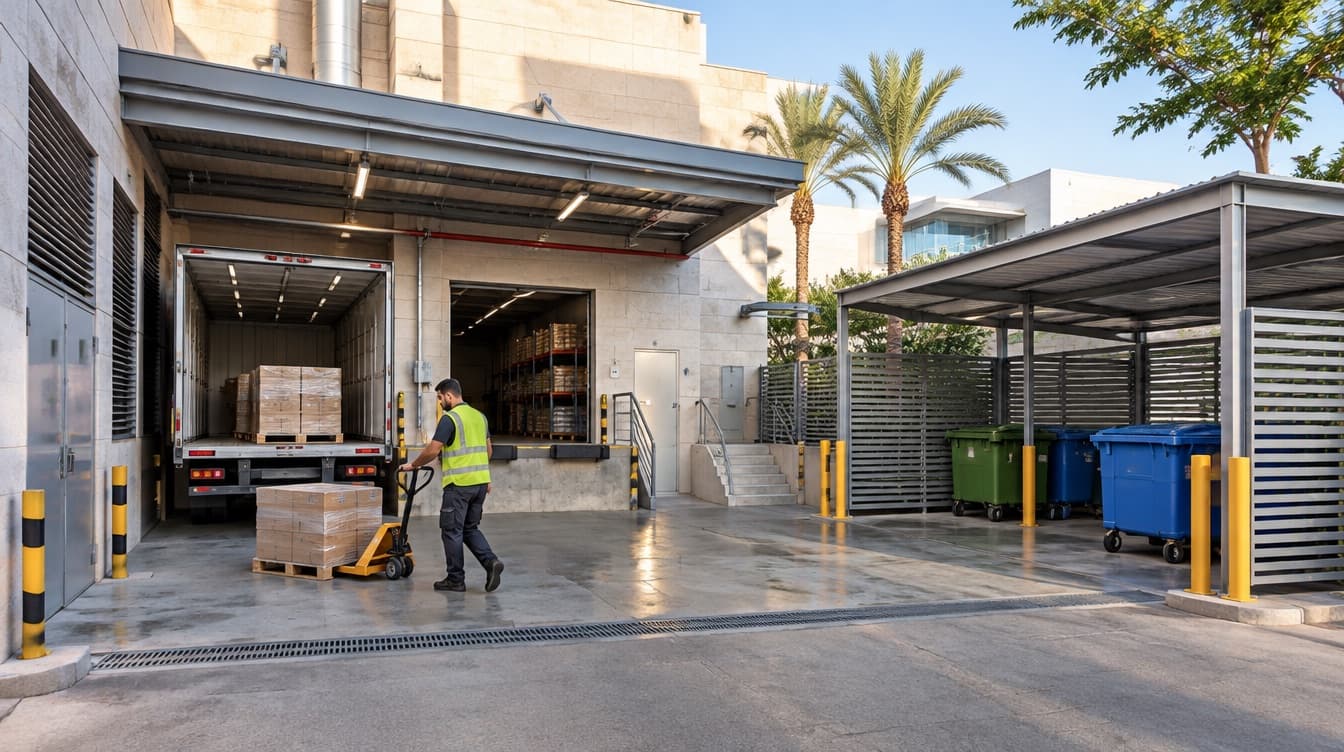
Transport for London publishes guidance on delivery and servicing plans for buildings. Three ideas from it work well in a retail center: a booking system for dock slots, moving deliveries to quiet hours, and consolidating deliveries from several suppliers into one trip.
- Booking a dock slot before arrival, with a limited stopping time. A truck parked at the car park entrance also blocks emergency vehicles.
- A service route: service corridors and a freight elevator, not the public walkways during operating hours.
- Trolleys with rubber wheels and floor protection, so the paving does not crack.
- No goods in the corridors. Cartons in a service corridor block an escape route.
- A dock supervisor during peak hours. Without a person on site, delivery windows are a recommendation.
Waste, recycling and grease
Waste is the issue visitors notice first, by smell and by sight. So you define streams, locations and times, and every tenant knows exactly what is expected of it.
- Flattened cardboard into the compactor or the cardboard container, not the general bin.
- Packaging, glass and organic waste in separate containers, according to what the local authority collects.
- Closed bags, only in the waste room and only at the set times.
- Waste from works inside a store is removed by the tenant, not put into the center's containers.
Grease from kitchens is a risk to the sewage system of the whole center. The rules of Israel's municipal water corporations on industrial wastewater define a grease separator as a device installed before discharge into the public sewer, and the actual requirements are set with the water corporation and in the conditions of the business license. What the center can require in the handbook: used oil is collected separately, the tenant keeps a log of separator emptying, and a copy goes to management on request.
Equality in charging, not only in enforcement
Tenants that generate much more waste, mainly food tenants, usually contribute to the cost of removal under a mechanism set in the lease, not only by area. The professional statement of RICS, the British organization of surveyors and property managers, on service charges in commercial property requires an apportionment schedule of the costs to be given to tenants every year, and prohibits charging more than the actual cost. The principle is useful here too: every tenant should be able to see how its share was calculated.
The same logic applies to discounts. The benefit for an anchor tenant is usually given in the rent, and in the service charge everyone pays the same rate. If the property owner chooses to also reduce the service charge, the owner subsidizes the gap, and the lease needs to say so explicitly. If the gap quietly rolls over to the other tenants, they can claim discrimination, and rightly so.
Signage: approval before production, not after installation
The center needs a signage guide: location, size, materials, lighting and illumination hours. The tenant submits a visualization, receives written approval, and only then orders the sign. That way you never end up with a sign that is made and paid for but not approved for installation.
- Installation only by an insured installer, and with advance coordination. Work at height requires workers trained under the Work Safety Regulations.
- An external sign usually also needs a signage license from the local authority, under its bylaw. The handbook states that this is the tenant's responsibility.
- Temporary signs, stickers on the glass and A-frame signs in the walkway are allowed only under the rules, and not at the expense of walkway width.
Works inside the store
Works in a store can damage the systems of the whole center. A sprinkler moved without coordination, a covered detector or a cut pipe also affect the neighbors. So the handbook states that every tenant contractor goes through the same process as a center contractor: approval of plans, a certificate of insurance, a work permit for hot work or work on fire suppression systems, and a joint completion inspection.
The enforcement ladder
Good enforcement is predictable and equal. The tenant knows in advance what the violation is, what the response is, and that it applies to the largest tenant in the center too.
- A verbal reminder, with a reference to the section in the handbook, and a short record in the system.
- A written warning with a photo, the date, the time and the section that was breached.
- Charging the actual cost of the cleaning or repair the tenant caused, with the supplier's invoice.
- A payment set in advance in the lease for a repeated violation.
- A management meeting with the business owner and, if needed, exercising the remedies in the lease.
Note the fourth step. Under section 15 of Israel's Contracts (Remedies for Breach of Contract) Law, a court may reduce agreed damages that were set without a reasonable relation to the damage that could have been foreseen. An amount that looks like a penalty rather than an estimate of damage may not stand up, so it is worth tying it to a real cost: cleaning, removal, security time.
We wrote about the clauses worth including in the rules of a retail center in the checklist for drafting agreed house rules. On the importance of consistent enforcement, read why enforcing house rules matters.
What to write in the lease
- "The tenant handbook, as updated from time to time with advance notice, forms an integral part of this agreement."
- "The tenant is responsible for ensuring that its employees, suppliers and contractors act in accordance with the tenant handbook."
- "Center management may charge the tenant the actual cost of cleaning, removal or repair caused by a breach of the handbook."
- "The tenant shall present to management, on request, a log of grease separator emptying and certificates for the removal of used oil."
- "No sign shall be produced or installed before written approval from center management and a license from the local authority, where required."
Common mistakes, and why they happen
- A handbook that is not mentioned in the lease. This happens because the lease was drafted at the law firm and the handbook was written later by the operations team. The result: there is no way to enforce the rules.
- Selective enforcement. This happens because it is hard to confront an anchor tenant or a long-standing tenant. The moment one tenant is exempt, everyone feels exempt.
- Verbal sign approval. This happens under the pressure of an opening. Afterwards people argue about what exactly was approved, and the sign is already up.
- Arbitrary breach payments. This happens when the aim is to "deter". An amount unrelated to the harm is a point of attack in any dispute.
- Delivery windows with no one at the dock. This happens because the dock is seen as a back area. In practice, that is where it is decided whether visitors will run into a truck at the entrance.
How we do it
In the centers we manage, tenants open service calls and track them in the app, and our service center is available 24/7. Independent quality control inspects the public areas, the waste rooms and the docks. By the 10th of every month, the property owner receives a detailed expense report, line by line.
For details on the service see retail center management. On building the budget for a center like this, read a smart budget for a retail center.